About
Funded by the European Union’s Horizon Europe program, QOSiLICIOUS aims to develop an optically active, all-silicon QKD solution that eliminates the need for rare semiconductor materials, addressing key challenges in chip-scale QKD assembly. This approach is expected to drive a paradigm shift by significantly simplifying the integration of QKD into microelectronic systems, facilitating its widespread adoption as a standard component of a secure communication infrastructure. The project envisions QKD as a transformative solution for the Information and Communication Technology (ICT) sector, offering Information-Theoretically Secure (ITS) encryption in applications where conventional security primitives remain vulnerable.
Long-Term Vision
Integrate QKD on an all-silicon basis, which enables its seamless and cost-efficient integration in last-mile networks and handheld devices such as smartphones. As the era of quantum computing approaches, this technology will help to mitigate cyber threats to the increasingly interconnected ICT infrastructure that underpins modern personal and professional communications.
Mission
Objective 1: Advancing Silicon IC Platforms for Quantum Optics
We aim to integrate active quantum-optic sources into silicon platforms for QRNG and QKD. This includes a monolithic silicon LED and a GeSi waveguide diode for 1550 nm QKD. Future refinements will enable E-band operation for free-space QKD.
Objective 2: Miniaturized QRNG Pixels and QKD Transmitters
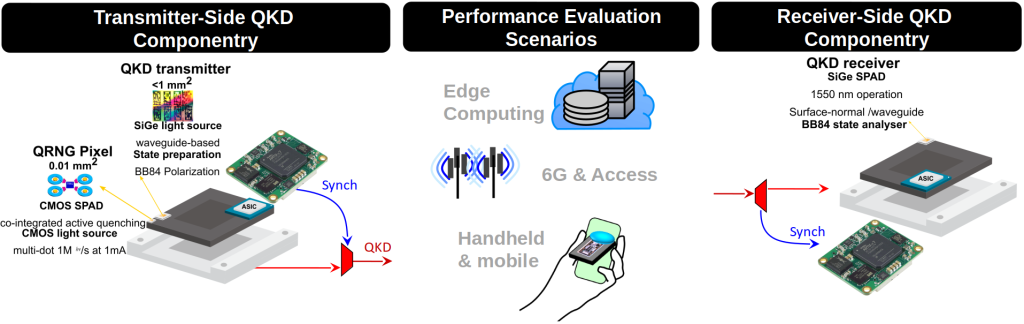
We aim to develop compact quantum engines for seamless integration with electronics. The QRNG engine will have a <0.01 mm² footprint for 2.5 Mb/s true-random number generation. A 4-pixel QRNG will demonstrate scalability.
The QKD transmitter will be <1 mm², delivering 10 kb/s secure-key rate using a GeSi light source, a BB84 polarization encoder for fiber and free-space key exchange.
Objective 3: GeSi-Based Single-Photon Detector for Quantum Applications
GeSi SPADs enable seamless integration into silicon QKD receivers, reducing reliance on costly III-V materials while offering lower afterpulsing than InGaAs/InP at similar temperatures, supporting higher QKD bit rates.
Two GeSi SPAD types will be developed. Target performance includes 50%/20% photon detection efficiency (wg/sn) in the C-band, dark count probabilities of 10⁻⁴/10⁻³ in a 1-ns gate, and <0.5 µs dead time.
Objective 4: Cost-Effective QKD for Intra-Datacenter and 6G Applications
Chip prototypes will be tested in large-scale, cost-sensitive QKD applications, assessing secure-key rate (SKR) and quantum bit error rate (QBER) under optical loss and coexistence with classical systems.